The Bible in 365 Days

I, along with a friend, will be reading through the entire Bible this year. I’ve tried a couple of times; was so eager to do it once that I attempted (and failed at) a 90 day plan. After awhile it became more and more ridiculous to talk about Christianity without having read the book. So…here…goes…everything…

PS: You can be a Christian and not read the Bible, right?

Violence

Is the language of the inarticulate and a riot is the language of the unheard.

I am not well versed in geopolitical matters. I am not a student of international affairs. I know that what I write is spoken mostly from gut reaction to what I see as oversimplification of a serious issue: terrorism.  I don’t know why a young couple would murder innocent people or why dozens of men and women lost their lives listening to music in a concert hall, but I know using the umbrella term of ‘terrorism’ brings us no closer to understanding what we’re up against.

After 9/11 happened, the best explanation local newscasts could give a shell-shocked city was that ‘they’ hate everything we stand for and that’s why they wanted to kill us. Yeah…talk like that makes it easy to identify a villain and pick a fight, but I don’t want anymore fights. I have children and I don’t want them to be desensitize to this kind of thing happening. I don’t want them to grow up thinking that violence is normal, or the problem; violence is the weed, not the root. To kill the plant, you attack at the thing that anchors it into the ground. And don’t be fooled, it’s not religion. Religion has been a long time scapegoat of extremists. If we all believed the same thing, rest assured, terrorism would still exist because there  will always be people who do not believe in equality and access for everyone.

And there it is: if you want to know why someone is violent, find out what it is they lack; see the need and you’ll find the answer.

Is the Post-Baby Body a Big Deal?

I’ve had two babies; gained 30 pounds with the first and was back to my pre-pregnancy weight within 8 weeks. My second pregnancy, I gained 40 pounds and lost all but ten. I remember wondering, as I started seriously putting on the pounds in the third trimester of both pregnancies, if I would lose the weight. After years of seeing the front covers of tabloids with headlines touting how this celeb ‘got her body back’ within days, weeks, months, whatever, I was beginning to think that the baby weight would be like Atlas, carrying around a burden I could never lose.

But it was never like that. Even the second one where I didn’t lose all the weight, I still fit into my clothes. The average woman, with a healthy BMI, should gain 25-35 pounds during pregnancy. With the breakdown of the added pounds looking something like this:

Baby: 7-8 pounds
Placenta: 1-2 pounds
Amniotic fluid: 2-3 pounds
Uterus: 2 pounds
Increased blood supply: 3-5 pounds
Fluid, fat, breast tissue: 10 pounds

So after delivery, in terms of losing the weight, you’re already about half way there, and, if you choose to, the benefits of breastfeeding make the rest of the way less of a drag. So why all the fuss when someone famous does this relatively easy thing that women have been doing for eons? Why do we make it seem like baby weight is one of the easiest things to put on and the hardest to get rid of?

Married At First Sight: The Missing Link

Had no clue what I was going to write about tonight, but I decided to stick with the marriage theme this time extending into reality TV. Married At First Sight is a social experiment, but not really, after all arranged marriages have been around for centuries. The real appeal of the show is almost akin to watching Fear Factor; the attraction is the shock and awe of seeing real people doing something you would never do. The premise: three couples are matched by four experts; they marry sight unseen, go on a honeymoon, and move in together over the course of six weeks and at the end decide whether or not to stay together. The first season was mostly a success with two couples staying married. Last season…not so much. Everyone divorced leaving viewers wondering if after only two showings, whether or not the show had run out of steam.

My gut says the show’s problem is in it’s all white panel of matchmakers. The first season, despite not being a fan of the show, I was disappointed to see that the lone black couple got a divorce. When all three pairs split the following season, I figured out the problem: there’s a culture gap between the experts and the participants of color. Personality, character and dealbreakers are all nice to talk about, but much of that stems from where and what they grew up in. If the show wants better success, they need to incorporate feedback from family to give a fuller picture of what kind of person is looking to get married.


The Key to Successful Marriage

I’m married. Haven’t been for very long, but I’ve realized in that short period of time that happiness or love is one of the worst reasons to marry someone. Don’t get me wrong, my husband provides me with both, but that’s not really why we’re together. If my highest expectation were solely emotional, then our union would be a perpetual roller coaster with every twist and turn dependent upon time, circumstance and my mental health, not an easy foundation to build a life upon.

True compatibility is based on how well we fit the roles in our relationship, not how many hobbies we have in common or our familial or ethnic backgrounds. Marriage fills a need for partnership. For me, that meant someone who was a hard worker, steadfast, creative, good father material, spiritual, honest and a few other things. So when I think about marriage now, versus how I used to, I see it more like a business: I’m looking to pick someone that I can invest with, someone whose skill sets, mission and vision, complement my own. Seeing marriage this way, opened up the dating world for me because my suitor pool wasn’t just filled with candidates who were over 6 ft, with a full head of hair, at least a bachelor’s and making a certain salary.

Now, his looks were the icing, not the cake. Now, it was ok if he was short and not making a whole lot because he was patient, had tremendous respect for me and was amazing with kids; now, it was ok that he wasn’t well educated, but had a great sense of humor, stable career and an empowering vision for himself and his future. Now, marriage could be about the everlasting intangibles instead of the whether or not there’s motion in the ocean.
Shame the Black Away

I was on Larry Elder’s twitter to prepare for this post (believe me, I don’t go looking for Larry Elder quotes) and noticed his reply to one of the comments made about him: ‘What’s the difference, between calling a white guy a “nigger lover” vs. calling a black an “Uncle Tom”–as you’ve just done to me?’ I’ve heard lots about Elder over the years; his ultra conservative perspective and sometimes, seemingly anti-black sentiment is tough to sit through, especially when he’s spouting his ideology in front of a white viewership. I used to think he was an Uncle Tom until I realized how much that played into the stifling mainstream perception of black people as monolith.

Folks (of all ethnic backgrounds) get away with calling  out black people for not being ‘black enough’. This kind of shaming is still acceptable because we still intrinsically believe there are certain things that all black people do and say, after all, that is a form of solidarity, no? NO! It’s actually called groupthink. The past couple of months, I’ve seen the ‘blackness’ of popular Twitter targets, Don Lemon and Raven Symone, called into question. When Stacey Dash endorsed Mitt Romney in 2012, the b(l)acklash was fierce and furious (and foolish).

There’s something unsavory about the pass we give shaming African Americans whose opinions are on different ends of spectrum. The silent endorsement shores up the idea that only certain kinds of public expression of black thought are acceptable, forcing fresh perspectives out of the spotlight and reinforcing the status quo.

The Perfect Diet

“I have given you every herb that yields seed which is on the face of all the earth, and every tree whose fruit yields seed; to you it shall be for food” (Genesis 1:29)

That was God’s instruction to Adam and Eve, the first man and woman according to the Old Testament. So, in a perfect world, people didn’t eat animals? At least, up until the flood, everyone were vegetarians? As many times as I’ve read Genesis, I’ve always missed that.

Where’s God?

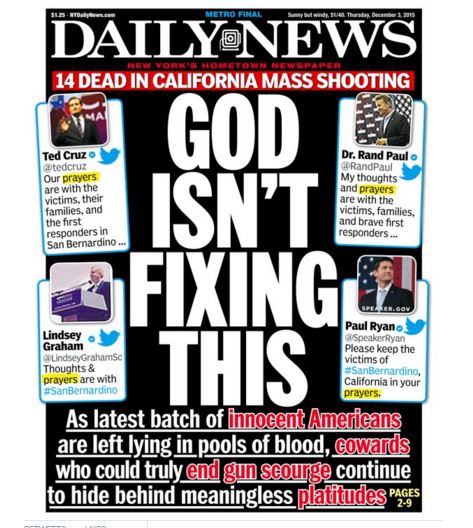
Daily News posted this image on their Twitter account today:

NY Daily News

Left me wondering, not where is God when tragedy strikes, but what is it we want God to do when we pray after things like this happen? I don’t mind praying: communication with God is an important part of spiritual growth and relationship, but has it become a cowardly, even cliché alternative to action?

It’s much easier to tell your newly evicted aunt that you’ll pray for a new job than to offer her your pull out couch to sleep on. After all, you don’t have the space (and how long is she really going to stay…). Once we start thinking about the real answer to the prayer (which, without a doubt, would require some discomfort and effort on our part), it’s much easier to just give it to God and ask him to do something…anything.

Some of the greatest things that God has ever done…was through willing people. When tragedy strikes, people ask where was God or why couldn’t God have done something, like a ‘part the Red Sea’type of moment, often forgetting that God used Moses’ hands to do that.

When people suffer, it’s time to put our hands together to work and pray.

When Twitter Goes Wrong

Today marks the 60th anniversary of Rosa Parks’ bravery against segregation. The moment was memorialized all over Twitter with one tweet from the RNC receiving hundreds of retweets. It reads, ‘Today we remember Rosa Parks’ bold stand and her role in ending racism.’ Yeah, that ‘ending racism’ part didn’t go over to well and made the comment the butt of more that a few jokes. I was sure it was fake, so I checked it out and it turns out, it’s real…and two years old. That’s right. One of today’s most tweeted is a goodie, but definitely an oldie. When a sharp eyed reader pointed it out, AJ Plus (a digital media provider from Al Jazeera) made no comment; very slick (and questionable) move for a content provider tied to a news organization, but that’s the power and danger of Twitter: the word gets out faster than anyone can bother to say ‘retract’ and even if there’s a correction, who cares?! Hundreds have already spread the word on their own feeds, in the process, giving the fledgling channel a much needed boost, and a easy target, one more kick.

aj plus

Dancing With the Stars – the Scam

Ok, so I had time on my hands and I haven’t written anything for awhile. So why not find something meaningless to overthink? Like Bindi Irwin’s recent DTWS win. It’s not so much about Bindi, but her partner, Derek Hough, who is now a 6-time mirrorball trophy winner. No one else on the show comes close to that tally. He’s talented, for sure, but how has he managed that kind of success while other cast mates are lucky to make it to week two?

After doing some math, there’s no question that the powers that be at DTWS has their favorites and to the favorites go the spoils (with the spoils being the younger, more agile celebs). Over the course of the past ten seasons, there have been twenty-five professional dancers, only thirteen have participated in at least five of the last ten seasons (which was my only requirement to be included in the list below). Everyone is placed in order from the youngest partner age average to the highest:

Mark Ballas: 25                                                                                                                   Derek Hough: 28                                                                                                                 Valentin Chmerkovskiy: 33                                                                                             Karina Smirnoff & Peta Murgatroyd: 36                                                                       Sharna Burgess: 39                                                                                                             Cheryl Burke: 40                                                                                                                 Kym Johnson: 41                                                                                                                 Maxim Chmerkovskiy: 45                                                                                                 Emma Slater: 48                                                                                                         Tony Dovolani: 49                                                                                                               Anna Trebunskaya: 51                                                                                                       Tristan MacManus: 59

Fun facts: I was sure Derek Hough would be at the top of this list, but instead, it’s his good friend, Mark. While Derek has danced with older competitors (he won with 50 year old, Jennifer Grey and partnered with 43 year old, Ricki Lake), Mark hasn’t danced with anyone outside of their thirties. Other interesting tidbits: Tristan MacManus’ youngest partner was in their forties. Tony Dovolani is the longest running cast member (appearing in every season except the first). His average is what I would expect everyone to be around, but with a more than two decade difference between him and Ballas and Hough, it’s clear that producers, despite claims to match based on physical traits and compatibility, shield certain dancers from possible early exit by pairing them with likely frontrunners.